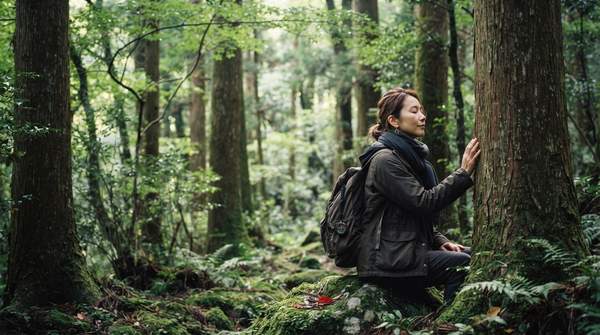
The intersection of mindfulness in contemporary art creation and appreciation offers a profound dialogue between the artist, the art, and the viewer. This space, where the ancient practice of present-moment awareness meets the modern canvas, reflects a cultural current: a collective yearning for deeper connection to our inner selves, each other, and the world.
Globally, 301 million people suffered from anxiety disorders before 2019, as reported by the World Health Organization. This number increased significantly in 2020, with an additional 76.2 million instances reported, according to a meta-analysis from the National Center for Biotechnology Information. Against this backdrop, many turn to holistic practices, with art re-emerging as an active tool for well-being—a sanctuary where the mind can pause, breathe, and simply be—rather than just an object of aesthetic contemplation.
What Is Mindfulness in an Artistic Context?
Mindfulness in art is the practice of bringing intentional, non-judgmental awareness to both the creation and the observation of an artwork. Its roots stretch back over 2,000 years to ancient Buddhist scriptures, but its modern application in wellness was largely shaped by Jon Kabat-Zinn in 1979. He defined it as "the awareness that emerges through paying attention on purpose, in the present moment, and non-judgmentally to the unfolding of experience moment to moment." When applied to art, this philosophy transforms our relationship with the creative process.

Think of it like this: for an artist, mindfulness is akin to a musician carefully tuning their instrument before a performance. It’s about attuning one's senses and consciousness to the present act—the feel of the brush, the viscosity of the paint, the texture of the canvas—without being preoccupied by the final outcome. For the viewer, the practice is like adjusting the focus on a camera. Instead of a quick snapshot glance, you intentionally slow down, allowing the artwork's colors, forms, and emotional resonance to come into sharp, clear focus. It is a shift from passive looking to active seeing.
- Present-Moment Focus: Directing full attention to the "now" of the creative or viewing experience, letting go of past interpretations or future expectations.
- Sensory Engagement: Actively noticing the visual elements—line, color, texture, light—as well as the physical environment of the studio or gallery.
- Non-Judgmental Observation: Witnessing the art and one's own internal reactions (thoughts, emotions, physical sensations) without labeling them as "good" or "bad."
- Intentionality: Consciously choosing to engage with the art in a slow, deliberate, and open-minded way.
How Do Artists Use Mindfulness in Their Creative Process?
For many contemporary artists, mindfulness is not merely a subject matter but an integral part of their studio practice. It is a method for quieting the inner critic and tapping into a more intuitive, process-driven state of creation. This shift reorients the goal from producing a perfect object to embracing the journey of making. The art lies not in escaping the process, but in fully inhabiting it.
Artists exploring profound philosophical concepts illustrate this approach, such as Khang Nguyễn, whose paintings delve into themes of nonduality, as noted by The Breeze. Nonduality, a concept central to contemplative traditions, focuses on a holistic awareness of reality where the distinction between "self" and "other" dissolves. His abstract works, with fluid forms and interconnected shapes, invite viewers to recognize connections between themselves, nature, and the universe. Creating such art becomes a meditation, an exploration of consciousness rendered in pigment and texture.
The Wignall Museum of Contemporary Art’s exhibit, "Affirmations Mindfulness in Contemporary Abstract Painting," explicitly spotlights the connection between studio art practices and mindfulness. By centering on this theme, the museum encourages a deeper understanding of the artist's internal process, prompting questions like: What if a painting's most important part is the state of awareness from which it was born? How does an artist’s inner calm or focused attention translate onto the canvas and affect the viewer?
A mindful approach prioritizes authenticity over technical perfection and vulnerability over polished performance, leading to art that is deeply personal yet universally resonant. The artist, chronicling a moment of awareness, offers more than an object; they provide a quiet space for others to enter and share.
Mindfulness Practices for Enhancing Art Appreciation
Mindfulness in art fundamentally changes how audiences experience it, transforming galleries and museums from cultural repositories into spaces for contemplation and self-reflection. The Royal Academy of Arts has explored this, discussing "the art of contemplation" and fostering mindfulness in galleries, suggesting wellness can be an active engagement with culture.
Accessible to anyone, this practice requires no special knowledge, only a willingness to slow down. The next time you are in front of a piece of art, you might try this simple exercise:
- Arrive: Stand before the artwork and take a few deep breaths. Notice your feet on the floor and the space around you. Let go of the urge to immediately read the label or understand the piece's history.
- Look: Allow your eyes to wander across the artwork for a full minute. Don't try to name or categorize what you see. Simply observe the colors, shapes, lines, and textures as they are.
- Feel: Turn your attention inward. What emotions or physical sensations arise as you look at the work? Notice these feelings without judgment. Is there a sense of calm, tension, curiosity, or joy?
- Reflect: After a few minutes of quiet observation, consider what the experience was like. What did you notice that you might have missed with a quicker glance?
Institutions are actively facilitating contemplative engagement: At Chaffey College, the Social Wellness and Behavioral Support team collaborated with the Wignall Museum to offer "Focus and Flow" meditation sessions. These events helped students connect with themselves while appreciating art, creating a synergy between internal well-being and external cultural experience. According to a paper published by UTC Scholar, engagement with visual arts may even increase mindfulness in the viewer.
Why Mindfulness in Art Matters for Our Well-Being
The integration of mindfulness and art has a tangible, positive impact on mental health, most clearly demonstrated in art therapy through Mindfulness-Based Art Interventions (MBAIs). MBAIs are innovative therapeutic approaches merging core mindfulness concepts with the creative and expressive processes of making art.
A meta-analysis of 17 studies (1,548 participants) found that MBAIs significantly reduce students' anxiety. However, research indicates the effect size varies by intervention duration, research design, and participants' learning stage, allowing practitioners to tailor approaches.
The therapeutic potential of art is evident in initiatives like "The Children's Sensorium," which a qualitative evaluation in the Journal of Art & Design Education showed uses sensorial contemporary arts, mindfulness, and play to support children's well-being. This approach helps children process experiences and build resilience by engaging their senses in a creative, non-judgmental environment, extending to adult stress reduction and post-pandemic recovery contexts.
As we move toward a holistic wellness model connecting mind, body, and environment, art and culture emerge as essential components. Mindfully engaging with a painting or sculpture anchors us to the present, offering respite from daily anxieties. One scholarly article suggests the full scope of benefits from interacting with art likely extends beyond current research, indicating an emerging frontier of well-being.
Frequently Asked Questions
How can I practice mindful art appreciation at home?
Mindful art appreciation doesn't require a museum. In a quiet space, choose an image—from an art book, postcard, or online—and set a five-minute timer. For the initial minutes, explore the image freely, noting colors, shapes, and details. Then, close your eyes to observe evoked feelings or thoughts. The goal is presence with the experience, not analysis.
What is a mindfulness-based art intervention (MBAI)?
A mindfulness-based art intervention is a therapeutic approach that combines mindfulness practices with the creative process of art-making. A session might involve a short guided meditation to focus the mind, followed by an art activity like drawing, painting, or sculpting. The focus is on the process itself—the sensations of the materials, the movement of the hands—rather than on the artistic quality of the final product. As research has shown, these interventions can be effective in reducing anxiety and promoting emotional well-being.
Do you have to be an artist to benefit from mindfulness in art?
Absolutely not. The benefits of mindfulness in art are available to everyone, regardless of artistic skill. For appreciation, the only requirement is a willingness to be open and present. For creation, the focus is on expression and process, not on technical ability. Doodling, coloring, or simply making marks on a page can be a powerful mindful practice if done with non-judgmental awareness.
What is the historical connection between mindfulness and art?
While the contemporary dialogue is new, the connection is ancient. Mindfulness originates in Buddhist philosophy, which has a long and rich history of artistic expression. Practices like mandala creation, calligraphy, and ink wash painting in Zen Buddhism are deeply meditative. These art forms are not just about creating a beautiful object but are considered a spiritual practice—a way of cultivating presence, discipline, and an understanding of the transient nature of reality.
The Bottom Line
The union of mindfulness and contemporary art offers a powerful antidote to our culture of distraction. It provides artists with a method to create from a place of deep presence and offers viewers a way to engage with art that is both restorative and profound. By embracing this mindful approach, we can transform galleries, studios, and even our own homes into spaces for genuine connection and well-being.