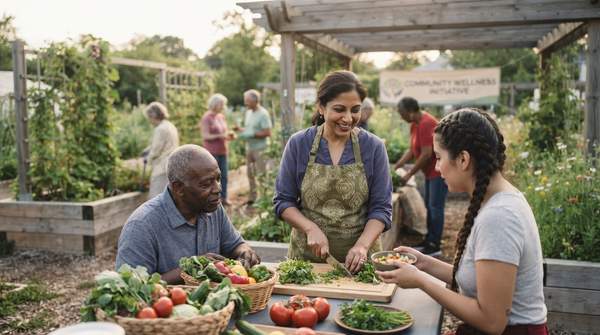
During the COVID-19 pandemic, the White Earth Nation achieved a remarkable 93 percent vaccination rate among its elders, revealing the profound impact of culturally-integrated health strategies. This high rate, reported by the Cdc, showcased how a deep understanding of community values can lead to exceptional public health outcomes. The White Earth Nation's high vaccination rate reveals the potential for comprehensive holistic well-being through cultural practices for mental and physical health in challenging environments.
The White Earth Nation’s achievement offers a powerful counter-example to the notion that high public health compliance is difficult without top-down mandates. Instead, it shows that a community-led, culturally-informed approach can be exceptionally effective, fostering trust and engagement from within. This approach contrasted sharply with many generic public health campaigns, which often struggled to connect with diverse populations.
Culturally-informed health interventions prove exceptionally effective in practice, but the broader discourse around 'holism' often struggles to genuinely incorporate cultural diversity or integrate with scientific rigor. This tension creates a significant challenge for achieving equitable health outcomes globally.
A truly effective and equitable future for holistic well-being will likely depend on health systems moving beyond superficial cultural gestures to deeply integrate diverse cultural practices and scientific methods, a shift many are not yet prepared for. This foundational change is essential for addressing the complex determinants of health.
Beyond Translation: Defining Cultural Competency
Translated materials and interpreter services bridge language differences, according to cdc.gov. These resources facilitate basic communication and information exchange, to make health information accessible across linguistic barriers. Yet, their utility often stops at surface-level understanding, failing to capture deeper meanings.
Such services often fall short in conveying complex health information or cultural nuances. Medical terms might lack direct equivalents, or cultural beliefs about illness and healing might be entirely missed. Sole reliance on linguistic translation overlooks deeper cultural contexts essential for effective and respectful healthcare delivery.