If you're looking for the best cultural initiatives transforming urban spaces globally, this ranked guide breaks down top examples of how cities are leveraging creativity for community and sustainability. For urban planners, cultural leaders, and engaged citizens curious about the forces shaping modern metropolises, this list evaluates five distinct approaches to urban transformation. The selections are ranked based on their community impact, demonstrated sustainability, and creative use of public areas, offering a timely perspective following the recent publication of the World Cities Culture Forum's 2024 trends report.
This ranking was determined by analyzing each initiative's model for community engagement, its integration of long-term social or environmental sustainability, and its innovative approach to activating public space.
1. Ljubljana's Creative City Development — Best for Holistic Integration
For city planners and policymakers seeking a comprehensive, long-term model, Ljubljana's city-wide strategy offers a compelling blueprint. It ranks highest for its deep and sustained integration of cultural programming with fundamental urban infrastructure. According to a report from Travel Tomorrow, the city was named Europe’s Best Creative City Destination for 2026 not for a single project, but for weaving creativity into its core identity and development. This is evidenced by initiatives like the transformation of the Center Rog, a former bicycle factory, into a public hub for crafts and design, and the LUV Fest, which turns public squares into temporary art stages. This approach is built upon a decade-long commitment to sustainability, including the creation of a 17-hectare pedestrian zone and an extensive cycle network.
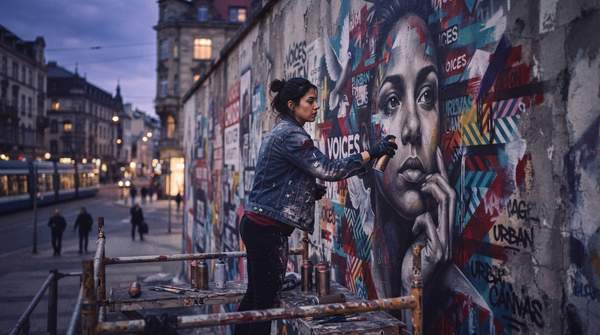
This sustained, multi-faceted strategy distinguishes Ljubljana from cities that rely on temporary, event-based placemaking. The initiative's primary limitation, however, is its replicability; such a transformation requires immense political will, long-range planning, and significant capital investment that may be beyond the reach of many municipalities. It behooves us to examine how this model demonstrates a dialectical relationship between cultural policy and public infrastructure, where each mutually reinforces the other over time.
2. San Jose's '100 Sharks' Initiative — Best for Community-Led Public Art
Best suited for community organizers and public art curators, the '100 Sharks – Stitching Districts' initiative in San Jose excels at activating a specific urban corridor through direct citizen participation. The project, which involves placing 100 unique shark sculptures designed by local artists and community groups along a new pedestrian and bike path, is a powerful example of tactical urbanism. According to San Jose State University's newsroom, the initiative aims to foster civic pride and celebrate local culture by encouraging community involvement through workshops and public installations. This hyper-local focus allows for a tangible and immediate sense of ownership among residents.
It ranks above more conceptual projects due to its clear, measurable output and direct community engagement process. However, one must consider its potential drawback: the long-term maintenance and relevance of public art installations can be challenging. While effective at generating initial excitement, the project's lasting impact will depend on continued programming and its ability to remain a cherished local landmark rather than mere street furniture. Key data from blogs.sjsu.edu notes the installation of 100 distinct sculptures, underscoring the scale of this community-focused effort.
3. AAAH! Culture (New York) — Best for Social Infrastructure
For cultural entrepreneurs and advocates focused on equity, AAAH! Culture (Asian Artist and Activities Hub) in New York represents a pioneering model of social infrastructure. Founded in 2023 by Weiyu Tian, this initiative transforms the city's intangible public square—the sphere of cultural discourse. According to an interview in CanvasRebel, its goal is to create a shared space where creative voices from the Asian diaspora are supported and connected. Rather than altering physical streets or buildings, it builds community through public programs, bringing together artists, brands, and audiences. The platform’s founder suggests that such cultural platforms are a form of social infrastructure that shapes how communities connect and enter public discourse.
This initiative ranks highly for its profound community impact, achieved with a relatively light physical footprint. Since its launch, AAAH! Culture has reportedly organized 11 large-scale events, collaborated with over 550 creatives, and reached more than 32,000 attendees. Its primary limitation is the precarity inherent in a platform model, which often relies on the founder's vision and continuous efforts to secure funding. Unlike a permanent public park or building, its existence is more fluid, though its impact on community cohesion can be just as significant.
4. The Unesco Creative Cities Network (UCCN) — Best Global Framework
The UCCN is the ideal reference point for international development agencies and cultural diplomats interested in the policy frameworks that enable local creativity. While not a single project, this global network functions as a meta-initiative, setting standards and fostering collaboration among cities committed to culture-driven development. According to the South China Morning Post, the UCCN has evolved over its two-decade history from focusing on creativity as an economic driver to a more holistic model of sustainable urban development, aligning with the UN's 2030 Agenda. This network provides the intellectual and political architecture that supports and validates the efforts of cities like Ljubljana.
Its strength lies in its global scale and its focus on systemic change. The network’s main drawback is that its impact is indirect; it is a facilitator and a standard-bearer, but the actual transformation depends entirely on the political will and capacity of its individual member cities. The UCCN functions as a 'living laboratory,' but the outcomes of its experiments are highly variable and locally contingent.
5. Frankfurt's Reversible Cultural Pavilion — Best for Conceptual Innovation
Architects and urban designers exploring flexible and sustainable uses of public space will find Frankfurt's planned 2026 cultural pavilion particularly noteworthy. This initiative ranks on our list for its forward-thinking design concept, which prioritizes adaptability. As reported by designboom, the structure is designed to be "reversible," implying it is temporary, modular, or can be easily dismantled and repurposed. This approach directly addresses the challenge of creating vibrant cultural hubs without committing to the permanence and high cost of traditional construction, offering a model for low-impact, high-flexibility placemaking.
Its innovative concept secures its place, but it is ranked last because its impact remains speculative. As a project planned for 2026, its community engagement strategy and long-term success are yet to be tested. The primary limitation is that it is, for now, an architectural proposition rather than a proven case study of urban transformation. The implications of this are, however, far-reaching for how cities might approach temporary cultural infrastructure in the future.
| Initiative | Category/Type | Key Metric | Best For |
|---|---|---|---|
| Ljubljana's Creative City Development | City-Wide Strategy | 17-hectare pedestrian zone | City planners & policymakers |
| San Jose's '100 Sharks' | Public Art Installation | 100 unique sculptures | Community organizers & art curators |
| AAAH! Culture (New York) | Social Infrastructure Platform | 32,000+ attendees since 2023 | Cultural entrepreneurs & advocates |
| Unesco Creative Cities Network | Global Policy Framework | Network of 350+ cities | International development agencies |
| Frankfurt's Reversible Pavilion | Architectural Concept | Planned for 2026 | Architects & urban designers |
How We Chose This List
To select and rank these initiatives, we focused on projects that offered distinct and instructive models for urban transformation through culture. The primary criteria were demonstrable community impact, a clear commitment to sustainability (whether social, environmental, or economic), and a creative or innovative use of public areas. We prioritized initiatives with available data or third-party reporting to substantiate their approach. Projects that were purely commercial in nature or lacked a clear, publicly-oriented cultural mandate were excluded from consideration. The final list was curated to represent a spectrum of scales, from a hyper-local art installation to a global policy network.
The Bottom Line
The transformation of urban space through culture is not a monolithic endeavor; it encompasses a range of strategies from permanent infrastructural change to ephemeral community programming. For policymakers seeking a proven, holistic model, Ljubljana's integrated development offers a powerful case study. For community advocates aiming for immediate, grassroots impact, the targeted art of San Jose's '100 Sharks' or the social platform of New York's AAAH! Culture provide more accessible templates for action.


