The rise of AI-generated music presents a clear and present danger to the core tenets of artistic creation, threatening to replace human authenticity with algorithmic efficiency and dismantle fair compensation for artists. While the technology that allows a machine to top the charts is a marvel of engineering, it forces a difficult conversation about the ethical implications of AI-generated music, particularly concerning authenticity and artist compensation, and what we stand to lose when the ghost in the machine learns to sing our songs back to us.
This isn't a far-off, futuristic debate. It's happening right now. With the recent launch of powerful new tools like Google's Lyria 3, the ability to create music from a simple text prompt is becoming universally accessible. We’ve already seen AI-generated tracks achieve stunning commercial success. An AI-penned country song credited to the fictional artist Breaking Rust hit No. 1 on Billboard’s country digital song sales chart. In the Christian music world, an AI ‘singer’ named Solomon Ray has also topped the charts. These are not niche experiments; they are mainstream incursions, competing for the same audience attention and industry accolades as human artists. The stakes, for musicians and for our culture at large, have never been higher.
Fair compensation for artists in the AI music era
At the heart of this technological gold rush lies a fundamental, and often ignored, question of theft. The cultural resonance of these AI models is built upon a vast foundation of existing music, much of which has been scraped and ingested without the consent of, or compensation for, the original creators. These systems learn to write a country ballad or a gospel hymn by analyzing thousands of examples, effectively learning the stylistic DNA of human artists. The result is a process that feels less like inspiration and more like a high-tech form of plagiarism.
The case of the chart-topping AI country song “Walk My Walk” is a stark illustration. According to a report from the Associated Press, the song’s vocal phrasing, melody, and overall style were derived from the work of Grammy-nominated country artist Blanco Brown, all without his knowledge. “I didn’t even know about the song until people hit me up about it,” Brown said, describing how his phone "kept blowing up" with messages from people who recognized his unique sound in the machine’s output. His artistic identity, honed over a lifetime, was reduced to a dataset and redeployed for someone else's profit.
This is not an isolated incident. The problem scales from chart-toppers down to independent artists. As reported by The Verge, folk artist Murphy Campbell was shocked to discover AI-generated covers of her songs, created from her live YouTube performances, uploaded to major streaming platforms under her own name. This unauthorized use of her voice and likeness creates a shadow discography she cannot control, profiting unknown actors and diluting her own creative work. These cases speak volumes about an ecosystem where an artist's voice, their most personal and unique instrument, can be digitally cloned and exploited. While AI companies are reportedly facing a wave of lawsuits over these practices, the damage is already being done, creating a landscape where legitimate songwriters are, justifiably, fearing for their livelihoods.
Is AI music authentic? Ethical considerations
Beyond the critical issues of copyright and compensation lies a more philosophical quagmire: the question of authenticity. Music, at its best, is a conduit for human experience. It’s the sound of a heart breaking, a spirit soaring, a community protesting. It’s rooted in the messy, beautiful, and often painful reality of being alive. What, then, are we to make of a chart-topping Christian song from an "artist" like Solomon Ray, who has no soul to save, no faith to profess, and no struggles to overcome? As one headline in Christianity Today pointedly asked, “The Current No. 1 Christian Artist Has No Soul.”
The success of AI in genres like country and Christian music, both of which place a premium on authenticity and storytelling, is particularly jarring. Some insiders have suggested that a portion of modern country music has become so formulaic and predictable that it's easily replicated by an algorithm. This is a harsh critique, but it forces us to look in the mirror. Have we created a cultural environment so hungry for familiar, easily digestible content that we can’t tell the difference between a human story and a machine’s facsimile? Or, perhaps more troubling, do we even care?
I believe the distinction between active and passive listening is crucial here. For the diehard fan, the active listener who pores over liner notes and connects deeply with an artist’s journey, authenticity is everything. The story behind the song matters as much as the melody. But for the passive listener—someone who just wants pleasant background noise for their commute or workout—the origin of the music may be irrelevant. The danger is that the sheer volume of AI-generated content, capable of being produced at an unimaginable scale, could drown out human artists, catering to the path of least resistance and conditioning us to accept a soulless substitute for the real thing.
The Counterargument
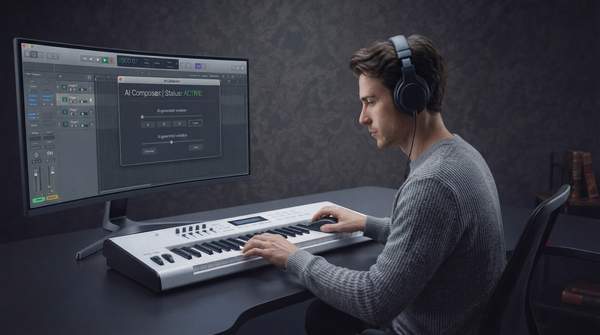
Of course, it’s important to acknowledge the optimistic view. Proponents of AI in music argue that these technologies are not a replacement for human creativity but an extension of it—a new instrument in the artist's toolkit. They envision a future where generative AI democratizes music creation, allowing anyone with an idea to bring it to life, regardless of their formal training or access to a recording studio. In this view, tools like Google’s Lyria 3, which can generate 30-second tracks from a simple prompt, are empowering. They can help a songwriter break through a creative block or allow a filmmaker to quickly mock up a score for their project.
Furthermore, an ethical path forward is not impossible. As highlighted by Bloomberg Law, some companies like Klay Vision Inc. are proactively entering into licensing agreements with all three major music labels, ensuring that their AI models are trained exclusively on legally licensed music. This approach respects copyright and provides a mechanism for compensating the original artists, suggesting that innovation and ethics do not have to be mutually exclusive. However, these responsible actors currently seem to be the exception, not the rule. The dominant narrative is still one of unauthorized data scraping and a "move fast and break things" ethos that leaves artists as collateral damage. The existence of a single ethical path doesn't negate the damage being done on the well-trodden unethical one.
The future of human creativity: AI music's impact
When I reflect on the music that has shaped my life, it’s never just been about the arrangement of notes. It was about hearing the crack in Janis Joplin’s voice and feeling her raw vulnerability. It was about the righteous anger of Public Enemy giving voice to a generation’s frustration. It was about the quiet devastation in a Joni Mitchell lyric that perfectly captured a feeling I thought was mine alone. These moments of connection are born from lived experience. An AI can simulate the sound of pain, but it has never felt it. It can replicate the structure of a protest song, but it has never fought for a cause. This is the crucial distinction we risk erasing.
Michael Smith pleaded guilty to creating hundreds of thousands of AI songs and using bots to generate billions of streams in a massive fraud scheme, exposing the fragility of current music systems. This AI proliferation fundamentally alters the economics and culture of creativity, making it difficult for human songwriters, who might spend a year crafting a single album, to compete in a marketplace flooded with millions of instantly generated tracks. The sheer quantity of AI output threatens the concept of artistic value and the future of human-penned art.
What This Means Going Forward
The music industry is responding to AI-generated content with new regulations and platform policies. The European Union's AI Act now requires AI providers to be transparent about their training data. Platforms are also taking action: Bandcamp has reportedly banned AI-generated content entirely, while Apple Music introduces voluntary 'Transparency Tags' for labels to identify AI usage. These represent initial steps toward accountability.
Technology continues to outpace policy, leaving the core ethical dilemma unresolved: machines are rewarded for mimicking human art, often without consent. This dynamic is creating a growing schism in the music world. One side will be a vast ocean of algorithmically generated "content," optimized for passive listening, playlists, and commercial backgrounds. The other will be a smaller, fiercely protected island of human artistry, where fans actively seek out and support creators for their stories, perspectives, and shared humanity.
The ultimate question is not whether AI can make music that sounds good. We already know it can. The question is whether we, as a culture, will have the wisdom and foresight to value the human creator behind the song. Will we build an ecosystem that nurtures both innovation and artistry, or will we allow the soul of music to be lost in the noise of its infinite, automated replication?