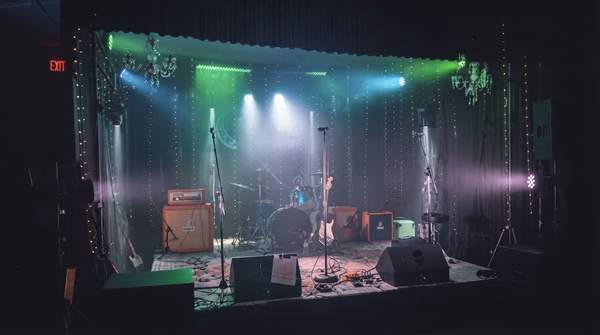
Have you ever imagined a spaceship landing in the middle of a funk concert? This wasn't just a flight of fancy; it was a reality for audiences of Parliament-Funkadelic in the 1970s, as their iconic 'Mothership' descended onto the stage. This spectacular act was more than just showmanship. It was a declaration, a portal to another reality, and a perfect entry point into understanding what Afrofuturism in music and visual arts truly is. It poses a question that resonates through decades of Black art: If the present is fraught with struggle and the past is marked by pain, where can we look for liberation? For many artists, the answer has been the future.
Afrofuturism, a term popularized by films like Black Panther and musicians like Janelle Monáe, is a deep tradition of philosophy, music, and art. It is not a new trend, but a lens through which systematically excluded communities create their own visions of the future. It counters mainstream science fiction, which has often been sterile, white, and oblivious to race and history. For those interested in culture, technology, and identity, Afrofuturism offers innovative and hopeful creative expressions from the last century.
What Is Afrofuturism?
Afrofuturism is an artistic and cultural movement that explores the intersection of the African diaspora with technology, science fiction, and futurism. At its core, it is a framework for imagining possible futures for Black people, often by drawing on elements of the past—from ancient African traditions to the history of enslavement and liberation. As author Ytasha L. Womack defines it, Afrofuturism is the "intersection of imagination, technology, the future and liberation," all centered on the experiences of the African diaspora. It's a way of looking forward while acknowledging, reinterpreting, and sometimes reclaiming a complex history.
Afrofuturism functions as cultural alchemy, taking the raw materials of history, mythology, and Black social realities and transmuting them through science fiction and fantasy. The resulting work is simultaneously forward-looking and deeply rooted in heritage. It challenges the idea of a single, monolithic future, proposing a multitude of possibilities. Core components of this philosophy often include:
- Reimagined Histories: Afrofuturism frequently engages in a form of revisionist history, connecting ancient African civilizations, particularly Egyptian mythology, with a high-tech future. This creates a continuum of Black history that bypasses the trauma of the Middle Passage and colonialism to establish a legacy of innovation and power.
- Technology as a Tool of Liberation: From the synthesizers of astral jazz to the digital worlds of modern hip-hop, technology is not just a gadget; it's a metaphor. It represents a means of escape, transformation, and empowerment in a world where other avenues have been denied.
- The Alien and the Other: The experience of alienation is central to the history of the African diaspora. Afrofuturism takes this feeling and turns it into a source of strength. Artists often adopt the persona of the alien or the android to comment on what it feels like to be an "other" in society, transforming a mark of exclusion into a badge of cosmic distinction.
- Spirituality and Mysticism: According to Google Arts & Culture, spiritual principles form the conceptual foundation of Afrofuturism in music. This can manifest as an exploration of cosmic consciousness, a connection to ancestral spirits, or the belief in music as a transcendent, healing force.

What are the historical origins of Afrofuturism?
While the term "Afrofuturism" is modern, its spirit has pulsed through Black culture for centuries. Critic Mark Dery coined the word in his 1994 essay "Black to the Future," analyzing the absence of Black voices in tech-obsessed science fiction. He named a sprawling, multi-generational artistic project that had long existed.
The roots, however, run much deeper. In an interview with GRAMMY.com, author Ytasha L. Womack argues that Afrofuturism is a "cultural and artistic practice that goes back to ancient African griot traditions and Egyptian astronomy." This perspective frames it not as a reaction to Western science fiction, but as an independent intellectual and spiritual tradition. It connects the storytelling of West African griots, the scientific achievements of ancient Egypt, and the coded language of Negro spirituals into a single, unbroken thread of speculative thought. The spirituals, with their recurring motifs of "flying away" or crossing over to a promised land, can be seen as an early form of Afrofuturist thinking—imagining an escape to another, better world as a means of surviving the brutalities of this one.
This ethos of flight and freedom became a powerful undercurrent in Black music. We can hear it in the birth of the blues, a genre that created a new sonic world from the ashes of oppression. We can see it in the defiant innovation of jazz, which constantly pushed boundaries and invented new languages of expression. The cultural resonance of these early forms laid the groundwork for the more explicit science-fiction themes that would emerge in the mid-20th century, as artists began to look not just to a heavenly promised land, but to the stars.
Who are the pioneering artists of Afrofuturism?
To grasp Afrofuturism, experience the work of its trailblazers—artists who built entire worlds with their own mythologies, aesthetics, and philosophies. They are the architects of this alternate reality.
Perhaps no figure is more central to the Afrofuturist canon than Sun Ra. A jazz composer, bandleader, and cosmic philosopher, Sun Ra claimed to be an angel from Saturn on a mission to preach peace to humanity. He and his band, the Arkestra, created a sound that was utterly otherworldly, blending big-band jazz with electronic noise, chanting, and free improvisation. His 1973 album and accompanying film, Space Is the Place, became a foundational text of the movement. Sun Ra reimagined what it meant to be a musician, seeing himself and his Arkestra as "musical astronauts" who "sail the galaxies through the medium of sound." He draped his performances in the imagery of ancient Egypt, creating a visual and sonic language that connected the African past with a cosmic future.
Following in Sun Ra's cosmic dust trails came George Clinton and his funk collectives, Parliament-Funkadelic. If Sun Ra was the movement's philosopher-king, Clinton was its high priest of funk. P-Funk created a rich mythology centered on characters like Dr. Funkenstein and Star Child, who battled the forces of conformity with the power of funk. Their most enduring symbol was the Mothership, a massive stage prop that would descend during concerts. This wasn't just a gimmick; it was a powerful symbol of arrival and salvation, an extraterrestrial vessel coming to transport Black people to a funkier, freer reality. It was a place, as Google Arts & Culture notes, where "Black folk could reclaim their blackness."
The influence extends beyond these two titans. Think of Jimi Hendrix at Woodstock in 1969, using his electric guitar and distortion pedals to deconstruct "The Star-Spangled Banner." He transformed the national anthem into a shrieking, futuristic soundscape of war and protest, using technology to rewrite a symbol of the nation. In the visual realm, the androgynous, cybernetic, and powerful persona of Grace Jones in the 1980s provided a blueprint for a different kind of human, one that transcended race, gender, and even biology. More recently, artists like Erykah Badu with her 1997 debut Baduizm, Janelle Monáe with her Cindi Mayweather android saga, and Flying Lotus with his psychedelic, genre-blurring soundscapes have carried the torch, proving that Afrofuturism is a living, evolving tradition.
Why Afrofuturism Matters
Afrofuturism, built on aliens, spaceships, and ancient myths, holds profound importance today as an act of radical hope. In a world that marginalizes Black people and denies them a future, this movement imagines one into existence. It offers, as one analysis states, a "hopeful vision to a community whose existence has long been marginalized and ignored by mainstream gatekeepers," demonstrating art's power to create space where none was given.
The political power of Afrofuturism is undeniable. By centering Black characters in narratives of technological advancement and future societies, it directly confronts the erasure common in mainstream science fiction. It asks, "Who gets to dream of tomorrow?" and answers with a resounding "everyone," empowering creators and audiences to see themselves as protagonists in human destiny, not as sidekicks or afterthoughts.
Engaging with Afrofuturism expands one's imagination. Listening to Sun Ra's Arkestra or watching the Mothership land in concert footage is not just consuming art; it's participating in a thought experiment about freedom. The future is a fluid concept, constantly being written and rewritten, and Afrofuturism ensures the pens are in the hands of those previously written out of the story.
Frequently Asked Questions
Who coined the term Afrofuturism?
The term "Afrofuturism" was coined by writer and critic Mark Dery in his 1994 essay, "Black to the Future." While he named the movement, the ideas and aesthetics had been developing in the work of Black artists for decades prior.
Is Afrofuturism a music genre?
No, Afrofuturism is not a single music genre. It is a broad cultural aesthetic and philosophy that influences many different genres, including astral jazz, funk, psychedelic hip-hop, R&B, and electronic music. It is better understood as an approach to art-making rather than a specific sound.
What are some modern examples of Afrofuturism?
Contemporary Afrofuturist examples include musicians Janelle Monáe, Flying Lotus, Erykah Badu, and Shabazz Palaces. In film and television, Marvel's globally successful Black Panther brought Afrofuturist aesthetics to a massive audience, while HBO's Lovecraft Country also explores its themes.
Why is space so important in Afrofuturism?
Space and cosmology are central metaphors in Afrofuturism, with the "final frontier" representing ultimate freedom—an "elsewhere" far from earthly oppression and racism. It also serves as a canvas for exploring spiritual consciousness, alien identity, and the potential for creating entirely new societies.
The Bottom Line
Afrofuturism is more than science fiction with Black characters; it is a cultural movement leveraging technology, mythology, and fantasy to confront real-world issues of race, history, and power. By envisioning alternative futures, it provides a language of hope and a blueprint for liberation.
Listen to Sun Ra's Space Is the Place, watch Janelle Monáe's Dirty Computer "emotion picture," or revisit the world of Wakanda. These examples concretely demonstrate Afrofuturism's power as an artistic movement, actively imagining the future in real time.