AI music is already topping charts, but artists fear for creativity.

In September 2025, an AI R&B artist named Xania Monet secured a $3 million record deal with Hallwood Media, a sum many human artists never achieve.

AS
Andre Silva

April 14, 2026 · 4 min read

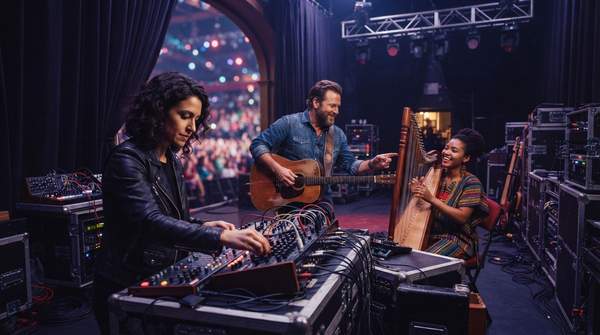
A futuristic music studio with AI interfaces and holographic soundwaves, juxtaposed with concerned human artists observing the scene.

In September 2025, an AI R&B artist named Xania Monet secured a $3 million record deal with Hallwood Media, a sum many human artists never achieve. A $3 million record deal with Hallwood Media for an AI R&B artist named Xania Monet, a sum many human artists never achieve, signals where the music industry sees its most lucrative future.

Yet, this aggressive embrace of AI-generated music, while propelling tracks to the top of charts and securing major deals, simultaneously sparks contentious lawsuits over copyright and widespread protests from human artists. The industry, from my vantage point at The Cultural Review, appears poised to accelerate AI adoption, prioritizing commercial efficiency and algorithmic output. This comes potentially at the expense of human creative control and fair compensation, unless significant regulatory or collective action intervenes.

The rapid ascent of AI music from novelty to commercial success demands a critical look at industry priorities. Hallwood Media's $3 million deal for Xania Monet, as reported by NYU Journal of Intellectual Property & Entertainment Law, is more than a tech investment; it's a financial speculation on algorithmic creativity now outpacing human talent. Hallwood Media's $3 million deal for Xania Monet alters the artist-label relationship, commoditizing music creation. Capital now flows towards the predictable and replicable, not the unique expressions of human experience. The implication is stark: the industry actively shapes a future where financial rewards favor automated production over authentic human artistry, creating a new economic model that bypasses established creative pipelines.

AI's Chart Domination and Mainstream Acceptance

AI-generated acts like Velvet Sundown have amassed millions of streams, with tracks topping Spotify's viral chart and a US Billboard country chart, according to The Guardian. Three AI songs even topped music charts in a single week on Spotify and Billboard. AI-generated acts like Velvet Sundown amassing millions of streams, with tracks topping Spotify's viral chart and a US Billboard country chart, proves AI's immediate power to capture mainstream attention.

Xania Monet became the first AI act to debut on a Billboard airplay chart, a significant milestone for algorithmic artistry, per Time Magazine. At least six AI or AI-assisted artists have debuted on various Billboard rankings recently, as confirmed by Billboard. Xania Monet becoming the first AI act to debut on a Billboard airplay chart and at least six AI or AI-assisted artists debuting on various Billboard rankings recently demonstrate AI music's ability to bypass traditional artist development and compete directly with human artists on commercial platforms. The industry, it appears, is actively cultivating a future where algorithmic output drives mainstream success, potentially reducing human artistry to a niche market.

The Growing Backlash: Copyright and Creative Integrity

Despite commercial successes, AI music generators like Udio and Suno face lawsuits for allegedly training on copyrighted music without consent, reported by NYU Journal of Intellectual Property & Entertainment Law. Lawsuits against AI music generators like Udio and Suno for allegedly training on copyrighted music without consent reveal a fundamental tension: AI innovation clashes directly with established intellectual property rights, raising critical questions about fair use and compensation for human creators.

The legal challenge against AI music generators ignited widespread artist resistance. Over 1,000 musicians, including Paul McCartney, contributed to an album protesting AI music that fails to compensate human artists, per Time Magazine. Over 1,000 musicians, including Paul McCartney, contributing to an album protesting AI music confirms the perceived threat to creative integrity and livelihoods. Yet, major labels' continued partnerships with AI companies, despite these protests, prioritize efficiency and profit over human artists' ethical concerns and creative rights.

Major Labels Bet Big on AI Artists

Major record labels, including Universal Music Group (UMG), Warner Music Group (WMG), and Sony Music, actively partner with AI music companies like Udio, Suno, and Klay, according to The Guardian. Major record labels, including Universal Music Group (UMG), Warner Music Group (WMG), and Sony Music, actively partnering with AI music companies like Udio, Suno, and Klay reveals a calculated push to integrate AI into their core business, moving beyond experiments to substantial collaborations.

The financial commitment is telling. Xania Monet's $3 million record deal with Hallwood Media in September 2025, documented by NYU Journal of Intellectual Property & Entertainment Law, followed a bidding war where offers reached $3 million, per Billboard. A bidding war where offers reached $3 million for Xania Monet's record deal confirms a willingness to prioritize scalable algorithmic output over the traditional, often unpredictable, development of human talent. Major labels are making a calculated shift, prioritizing risk-mitigated algorithms over human artistry.

What This Means for the Future of Music and Artists

The sustained commercial performance of AI artists like Xania Monet offers a glimpse into a future where algorithmic creations increasingly dominate charts and revenue. Xania Monet's 'Let Go, Let Go' climbed to No. 3 on the Hot Gospel Songs chart, and 'How Was I Supposed to Know?' peaked at No. 20 on the Hot R&B Songs chart, according to Billboard. Xania Monet's 'Let Go, Let Go' climbing to No. 3 on the Hot Gospel Songs chart, and 'How Was I Supposed to Know?' peaking at No. 20 on the Hot R&B Songs chart are not anomalies but indicators of AI's growing mainstream appeal.

Beyond chart performance, Xania Monet's catalog amassed 44.4 million official U.S. streams, reported by Billboard. Xania Monet's catalog amassing 44.4 million official U.S. streams confirms audience acceptance and commercial viability for AI content. Xania Monet's catalog amassing 44.4 million official U.S. streams fundamentally alters the landscape for human musicians, who now compete directly for listener attention and scarce industry resources.

Will AI replace human musicians in 2026?

While AI artists like Xania Monet achieve commercial success in 2026, a complete replacement of human musicians is not a consensus. Many industry observers, as noted by V13, see AI as a tool for augmentation and collaboration, enhancing creative processes rather than fully supplanting human artistry. The unique emotional depth and cultural resonance of human creators remain distinct from algorithmic output.

How does AI music affect the music industry?

AI music significantly impacts the industry by accelerating production cycles and potentially reducing creation costs, democratizing music creation for independent artists. Platforms like Suno, as discussed by NationalToday, allow individuals without extensive musical training to generate tracks, opening new avenues for creative expression and distribution. AI music accelerating production cycles and potentially reducing creation costs challenges traditional gatekeepers and established production models.

What are the ethical concerns of AI music generation?

Beyond copyright infringement and fair compensation, ethical concerns in AI music generation include questions of originality and artistic integrity. Critics worry that reliance on AI could homogenize sound or devalue the human creative spark. Concerns also exist about AI systems perpetuating biases from training data, leading to cultural appropriation or misrepresentation in music.

By Q3 2026, the continued financial success of AI entities like Xania Monet, or a significant legal setback for major labels, will likely determine the balance between technological innovation and human artistry in the global music market.