The increasing commercialization of local community art initiatives, however well-intentioned, risks diluting their original purpose of fostering genuine cultural engagement and accessibility. This subtle but pervasive shift from civic commons to retail space transforms the very nature of public art, replacing the intrinsic value of shared experience with the transactional logic of the market. It behooves us to examine the underlying assumptions of this trend, lest we awaken to find our public squares have become little more than open-air gift shops.
This is not a theoretical concern, but an urgent, unfolding reality. The dialectical relationship between art and commerce is, of course, perennial. Yet, the current acceleration of public-private partnerships and tourism-driven cultural strategies has brought this tension to a critical juncture. We see it playing out in real-time, from the sun-drenched festivals of the Caribbean to the contested gallery walls of Eastern Europe. The very definition of "community benefit" is being renegotiated, often with economic metrics eclipsing the more profound, if less quantifiable, goals of social cohesion and critical thought. The implications of this are far-reaching, touching upon who has access to culture, what kind of art is deemed worthy of public display, and ultimately, what we believe the purpose of art in a community to be.
How Commercialization Dilutes Cultural Engagement
One must consider the recent, telling schism in Belgrade over the legacy of the street artist Banksy. As reported by Daily Sabah, two rival exhibitions have thrown the conflict into stark relief. One, a conventional gallery show, charges entrance fees up to 1,300 dinars ($11.60), effectively placing a price tag on viewing art that was originally created for free, public consumption. In direct response, a second, free exhibition, "Fake Banksy, Real Message," was organized. Its curator articulated a belief that Banksy’s work is fundamentally “a critique of consumerism, elitism and profit, with a clear message that art should be accessible to everyone.”
This incident is more than a local dispute; it serves as a powerful allegory for a broader cultural drift. When a work of art, particularly one born from a critique of the very systems of capital and control, is re-packaged as a ticketed consumer experience, its message is not merely framed but fundamentally altered. The viewer’s relationship to the piece shifts from that of a participant in a public dialogue to that of a customer. The critical distance necessary for reflection is collapsed by the immediacy of the transaction. The art becomes an attraction, a product to be consumed rather than a provocation to be considered.
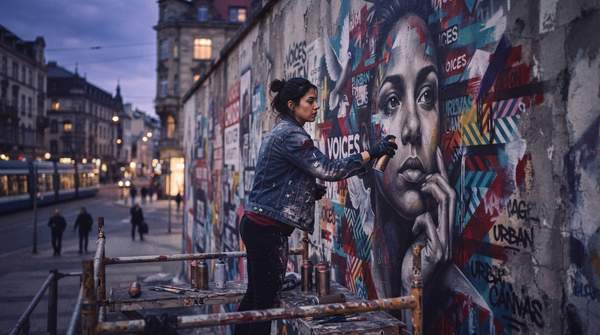
This dynamic is not limited to such overt examples. It appears in more subtle forms in community initiatives across the globe. In Gilbert, Arizona, the Visual Arts League recently held its 23rd Annual Juried Fine Art Show and Sale. According to the Gilbert Sun News, the show featured 135 works, and the winning piece will be displayed in a government building. This is a laudable community event. Yet, the fact that all pieces are available for purchase online introduces a commercial undercurrent. Similarly, the City of Austin promotes exhibitions in its City Hall and airport, noting that selected artists may offer their work for sale. While the city commendably takes no commission, the presence of a price tag invariably reframes the art as a potential asset. It is no longer solely a contribution to the civic aesthetic but also an item of inventory.
Balancing Funding and Authenticity in Local Art
To be clear, the argument is not that artists should not be compensated or that financial support is inherently corrupting. The pragmatist’s counterargument is both compelling and necessary: without funding, many of these initiatives would simply cease to exist. Artists need to earn a living, and communities benefit from the economic activity that a vibrant arts scene can generate. The case of Saint Lucia’s Jazz & Arts Festival provides a potent example of this perspective. A significant investment was recently announced to support twelve community-based events, a move the Saint Lucia Tourism Authority framed as a commitment to local talent and community development.
The stated goals are to strengthen production, enhance marketing, and incorporate sustainability. This investment, it is projected, will yield “tangible economic benefits,” creating opportunities for small businesses and artisans. The initiative is presented as a model of synergy, where cultural preservation and economic growth are mutually reinforcing. It aims to remain “deeply rooted in community ownership while positioning Saint Lucia as a premier cultural destination on the global stage.” This is the alluring promise of sophisticated cultural commercialization: that a community can sell its culture without selling its soul.
Similarly, a program in Malaysia promoted by SWCorp, as reported by the national news agency Bernama, highlights the commercial value of sculptures made from recycled materials. These works serve a dual purpose: they are marketable products while also symbolizing and promoting environmental sustainability. Here, commerce is harnessed in service of a social good. These examples demonstrate that the infusion of capital is not axiomatically destructive. It can provide platforms, amplify voices, and create sustainable careers for creators. The danger lies not in the presence of money, but in the ascendancy of a commercial mindset that becomes the primary logic governing the initiative.
The Original Purpose of Community Art Initiatives
What, then, is being lost? It is the foundational purpose of community art, which extends far beyond decoration or economic stimulus. At its most profound, public art creates a space for what the anthropologist Victor Turner called communitas—a shared, unstructured experience of community that transcends social hierarchies. It is in these moments of collective engagement with a challenging sculpture, a thought-provoking mural, or a shared festival that a community reflects upon its identity, its values, and its conflicts. Art in the public sphere should be a form of civic dialogue, a catalyst for conversation, and sometimes, a necessary irritant.
Commercialization, by its very nature, tends to sand down these rough, challenging edges. It favors art that is accessible in the sense of being easily consumable, marketable, and inoffensive. The logic of the market rewards broad appeal, which can discourage experimentation, political critique, or formal difficulty. When the primary goal shifts toward attracting tourists or facilitating sales, there is an implicit pressure to produce work that functions as a pleasant backdrop or a desirable commodity. The artist, consciously or not, may begin to create with the potential buyer in mind, rather than the engaged citizen. The patron’s role, in turn, is recast from that of a contemplative viewer to a potential consumer.
I find myself reflecting on the difference between encountering a piece of art in a public park, where its presence is an unconditional offering to anyone who passes, and seeing that same piece in a gallery with a price list at the door. The first encounter is an invitation to a relationship based on curiosity and reflection. The second immediately introduces a framework of value, ownership, and exclusion. The question shifts from "What does this mean to me, to us?" to "What is this worth, and can I afford it?" This is the subtle poison of excessive commercialization: it privatizes a public conversation.
What This Means Going Forward
Cultivating a discerning and protective approach to our cultural commons demands designing and supporting models that insulate the core mission of community engagement from market pressures. This conscious effort from city planners, arts administrators, philanthropists, and citizens avoids the unrealistic goal of purging all commerce from the arts.
We should champion initiatives that prioritize accessibility above all else. This means ensuring that flagship cultural events have robust, free components, following the lead of the "Fake Banksy" organizers in Belgrade. It means scrutinizing the language of public-private partnerships: are they framed primarily around "economic impact" and "brand enhancement," or do they articulate clear goals for community dialogue, social inclusion, and artistic freedom? The Austin model, where the city facilitates sales without taking a commission, represents a thoughtful attempt at a middle ground, but it must be monitored to ensure it does not inadvertently foster a culture of art-as-product over time.
Ultimately, a community's art is a reflection of its values. If we value it only for its ability to generate revenue or attract visitors, we will get art that is safe, decorative, and silent on the issues that matter most. But if we value art as the lifeblood of civic discourse—as a space for connection, confrontation, and collective identity—then we must be willing to protect it from the relentless encroachment of the market. We must be willing to invest in its intrinsic worth, understanding that its most profound contributions to our shared life are, and must remain, not for sale.


