Culture

Beyond the Canon: Why Being 'Cultured' Is No Longer About What You Know

The traditional definition of being "cultured" is obsolete. This article explores how cultural value has shifted from rote consumption of a fixed canon to a deeply personal engagement with diverse forms of expression.

EV
Eleanor Voss

April 7, 2026 · 6 min read

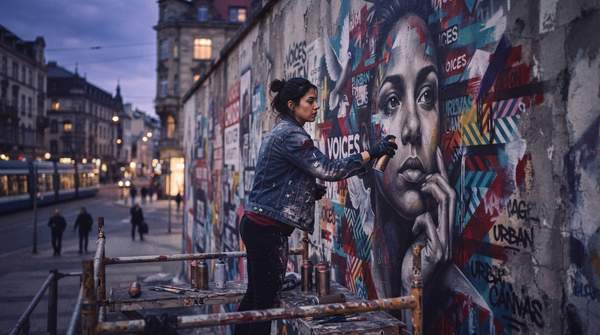
A diverse group of individuals interacting with a blend of traditional and modern cultural expressions, symbolizing the evolving definition of being 'cultured' in the digital age.

The contemporary debate over what it means to be cultured today reveals a profound societal shift; the term no longer signifies a shared, stable canon of high art but has instead become a fractured and deeply personal signifier of identity. This evolution from a monolithic standard to a pluralistic, often contentious, collection of subcultures demands a more nuanced framework for understanding cultural value, one that prioritizes individual engagement over rote consumption.

A contested definition of cultural literacy makes conversations about art, society, and shared values infinitely more complex. This erosion of a common cultural lexicon reflects deeper currents of social fragmentation and the changing nature of authority in a digital age, challenging our ability to find common ground and connection in a world saturated with information yet starved of shared meaning.

The Evolving Definition of Culture in the 21st Century

Historically, to be "cultured" was to possess a specific form of capital: a familiarity with the Western canon of literature, classical music, and fine art. This knowledge served as a social demarcation, a quiet signal of education and class. Today, that singular definition has splintered. One writer for pittnews.com usefully distinguishes between two coexisting spheres: 'classic culture,' comprising media produced decades ago that retains significance, and 'current culture,' a more ephemeral domain largely driven by younger generations. The latter is characterized by a relentless churn of trends, memes, and micro-celebrities, where relevance can evaporate in weeks.

This bifurcation has created a new kind of social pressure. As the same writer notes, there now appears to be a pervasive competition in society over who has consumed the most media or is most attuned to the latest trends. To be ignorant of a viral TikTok sound or a trending Netflix series can, in certain circles, feel like a greater social failing than never having read Shakespeare. I have, myself, been on the receiving end of such judgments; as one source reported, I have been called "uncultured" for my particular media consumption habits. This personal experience, which I suspect is far from unique, highlights a critical shift: cultural currency is now as much about velocity and volume as it is about depth and historical weight.
Diverse Perspectives on What It Means to Be Cultured

The fragmentation of cultural standards has inevitably led to conflict over whose culture holds value and who gets to decide. These are not abstract academic debates; they manifest in the fierce public square of social media and influence everything from museum acquisitions to school curricula. The contemporary American phenomenon of "Cancel Culture" is perhaps the most visible battleground for these warring perspectives. According to a 2021 report by the Pew Research Center, there are starkly differing views on the matter. For some, it represents a long-overdue mechanism for holding public figures accountable, while for others, it is a dangerous form of censorship and punishment that stifles free expression.

Without shared foundational texts or artistic benchmarks, individual cultural choices—like the music we stream, films we champion, and influencers we follow—become potent declarations of our values, woven into our identity. Consequently, criticizing cultural taste feels like criticizing personhood. This personalization allows unprecedented individual expression but also intensifies cultural disagreements, turning differences of opinion into moral crusades.

The Counterargument and Its Limits

One must consider the counterargument: that the dissolution of a common cultural canon is a net loss for society. Proponents of this view argue that a shared body of knowledge—the "great books," the symphonies, the masterpieces of art—provides the essential connective tissue for a cohesive public life. It gives us a common set of references, metaphors, and stories through which to understand ourselves and each other. Without it, we risk retreating into isolated cultural tribes, speaking mutually unintelligible languages of niche references and algorithmically-curated content.

While this concern for social cohesion is valid, the argument for a return to a single, static canon is both nostalgic and untenable. It ignores the fundamental principles of how culture operates. As outlined by cultural evolutionary theory, culture is not a fixed monument to be preserved in amber; it is a dynamic, adaptive system that is constantly changing. The forces of globalization, migration, and digital technology have irrevocably expanded the pool of cultural inputs, making the elevation of one tradition over all others seem not only arbitrary but exclusionary. To insist on a singular, Eurocentric definition of "cultured" in the 21st century is to ignore the rich tapestry of human expression and to deny the lived experiences of a vast portion of the global population.

A Personalist Reframing of Cultural Worth

If the old benchmarks are obsolete and the new ones are hopelessly fragmented, where do we turn for a meaningful definition of what it means to be cultured? Perhaps the answer lies not in *what* we consume, but in *how* we engage with it. The philosophical tradition of Personalism, as explored by thinkers and writers, offers a compelling framework. As described in an essay on The Public Discourse, Personalism posits that the core of human experience is the inviolable dignity and unique subjectivity of the human person. It rejects materialism and emphasizes that each person is an irreplaceable center of meaning and value.

From a personalist perspective, being cultured is not about accumulating prestigious cultural artifacts or acquiring social status. Instead, it is using culture—whether a Beethoven symphony, video game, or graphic novel—to deepen one's understanding of the human condition. The value lies in the transaction between the person and the cultural object, in the reflection and self-discovery provoked by engaging with art as a unique, irreplaceable individual.

This approach moves beyond the simplistic binary of "high" versus "low" culture. A person can engage with a blockbuster film with more philosophical depth and emotional intelligence than another might bring to a celebrated opera. As David Brooks noted in a 2018 op-ed, personalist philosophy holds deep insights for navigating our current cultural fragmentation. It recenters the conversation on the human person as the subject and object of free action, a being whose worth is not contingent on their possessions or their media diet, but on their inherent dignity.

What This Means Going Forward

Redefining "cultured" along personalist lines shifts educational and social priorities: teaching critical engagement over cultural catechism, and valuing curiosity, empathy, and self-reflection as true markers of a cultured mind. The goal is no longer to produce individuals identifying canonical works, but to cultivate persons finding meaning, connection, and self-understanding through engaging with art and ideas, in whatever form.

This does not mean that all cultural products are of equal quality or that standards cease to exist. It simply means that the ultimate measure of a cultural experience lies in its capacity to enrich the human person. The future of what it means to be cultured will be less about the performance of knowledge and more about the quiet, internal practice of becoming more fully human. The challenge, then, is to build a culture that celebrates this kind of deep, personal engagement, resisting both the nostalgic pull of a singular canon and the chaotic, competitive consumption of fleeting trends. It is to affirm, in the end, that culture's highest purpose is not to sort us into hierarchies, but to connect us to ourselves and to one another.

More from Culture