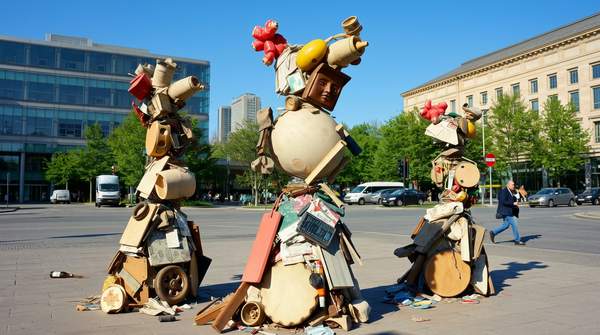
When wandering the streets of a city, most people see fire hydrants, discarded furniture, and weathered signs as simple background noise. For multidisciplinary artist Jorge Rivera Cardona, however, these everyday objects are the raw materials for a vibrant, city-wide art gallery. Based in San Juan, Puerto Rico, Cardona works at the intersection of art and socio-anthropology, transforming urban debris into compelling works that explore questions of identity and history. This guide offers insight into what to look for when choosing art exploring identity, and where Jorge Rivera Cardona fits within this contemporary movement.
His practice blends creativity and cultural criticism. Cardona recontextualizes found materials, prompting viewers to reconsider their relationship with their environment and the stories embedded within it. From public interventions to gallery installations, his work investigates the overlooked and forgotten corners of the urban landscape.
Inside the Studio: Our Conversation with Jorge Rivera Cardona
When we sat down with Jorge Rivera Cardona, he told us that his artistic process begins with a curiosity about the line between presence and absence in the modern city. "I am constantly observing what we choose to leave behind and what manages to remain," Cardona shared.
Drawing on his background as a socio-anthropologist, Cardona uses the concept of "interruption" to disrupt daily routines through transformed objects or spatial gestures. "If an artwork can make a passerby stop, even for a brief second, and re-evaluate a corner of the city they walk past every day without thinking, then the work has successfully opened a new door," he noted.
During our interview, Cardona shared how much of his creative energy comes directly from the layered histories of San Juan and the broader Caribbean diaspora. He rejects the idea that discarded street items are simply trash, viewing them instead as physical archives waiting to be decoded. "When I pick up weathered debris or discarded urban materials, I don't see waste—I see colonial memory, personal identity, and the habits of modern consumption woven right into the surface," Cardona explained. "These objects carry the real, unvarnished story of how our culture lives, consumes, and remembers."
He places these materials into an artistic context to examine how physical spaces and cultural identities shift. "Art shouldn't merely sit quietly in a gallery," Cardona added. "It should actively prompt us to question our environment and reconsider the hidden stories embedded in the world around us."
Core Mediums and Methods in Urban Material Transformation
Jorge Rivera Cardona employs a multidisciplinary approach, allowing the core question to dictate the form. This flexibility enables him to explore themes of identity and memory through various lenses, from the captured moment of a photograph to the tangible presence of an installation. Each medium offers a different way to interrupt the ordinary and reveal the hidden meanings within the urban landscape.
| Medium | Artistic Application | Thematic Resonance |
|---|---|---|
| Photography & Video | Documents public interventions and captures ephemeral moments in the urban environment. | Explores the fragile line between presence and absence. |
| Painting | Reinterprets found objects and street scenes with a subjective, expressive layer. | Adds personal and emotional context to public memory. |
| Digital Collage | Combines disparate images and textures to create new narratives. | Reflects the fragmented and layered nature of modern identity. |
| Installation | Uses physical space to immerse the viewer in a constructed environment. | Transforms a gallery or public space into a site of inquiry. |
| Public Intervention | Places art directly into the urban landscape, often unannounced. | Challenges the boundary between art and everyday life. |
Jorge Rivera Cardona's Inspiration for his "Street Fine Art"
Transforming street debris into fine art requires a conceptual grounding that connects the object to a broader cultural narrative. The practice of using found materials to explore identity builds on a significant history within contemporary art. Since the 1990s, exhibitions focusing on Caribbean artists have increasingly highlighted dialogues around identity and the experiences of marginalized groups, as noted by Museum of Contemporary Art San Diego . This historical context provides a foundation for artists who turn discarded items into symbols.
Jorge Rivera Cardona’s work investigates themes of consumption by selecting materials that speak to economic and social histories. A weathered piece of a building or a forgotten domestic item functions as a relic of a life lived, a symbol of economic change, or a marker of cultural presence. The artist acts as an interpreter, revealing the stories these objects hold.
Another factor is the intent to create an interruption in perception. Cardona states that he is not interested in mere illustration but in creating moments that suspend the ordinary. Placing a familiar but displaced object in a new context forces the audience to question their assumptions about what is present and what is absent in collective memory.
Where Jorge Rivera Cardona Fits in San Juan's Contemporary Scene
In the art scene of San Juan, Jorge Rivera Cardona occupies a space as an artist, socio-anthropologist, and curator. His work applies an intellectual framework to the material of the city itself. According to his own statements, his practice combines a fine art sensibility with a socio-anthropological perspective to dissect contemporary culture through the objects it produces and discards.
His focus on themes like colonial memory and diaspora aligns with the context of San Juan. Sourced directly from the urban environment, the work of Jorge Rivera Cardona is tied to the place of its creation as art made from Puerto Rico. His public interventions blur the lines between the gallery and the street, placing history and value directly into the public space.
Experiencing San Juan's Open-Air Gallery
Understanding an artist's intent and method provides clarity when evaluating work focused on identity. The work of Jorge Rivera Cardona transforms San Juan's streets into a gallery, drawing focus to discarded objects and the histories they contain. By blending socio-anthropological inquiry with a diverse artistic practice, he builds a commentary on memory and place. Explore the work of Jorge Rivera Cardona to examine how he approaches urban materials and contemporary art.
Frequently Asked Questions About Jorge Rivera Cardona's Work
What are the main themes in Jorge Rivera Cardona's art?
Jorge Rivera Cardona's work primarily investigates themes of identity, diaspora, and colonial memory. He also explores modern consumption and what he describes as the fragile boundary between presence and absence, using found objects to ground these concepts in physical reality.
What does it mean that he is a multidisciplinary artist?
As a multidisciplinary artist, Jorge Rivera Cardona does not limit himself to a single medium. His practice spans photography, painting, digital collage, installation, video, and public intervention, allowing him to choose the appropriate form for a particular inquiry or concept.
How does his work relate to the broader Caribbean art scene?
His work aligns with a movement in contemporary Caribbean art that re-examines the concept of diaspora. According to analysis from Mcasd, rather than focusing on a simple longing for a homeland, this art embraces the state of constant movement and identity transformation. Cardona's focus on memory and place within San Juan contributes directly to this dialogue.
What role does curation play in his practice?
Jorge Rivera Cardona identifies as a curator as well as an artist. In his work, this curatorial eye is evident in how he selects and arranges found objects from the urban environment, organizing the city's history and debris into a cohesive artistic statement.
Why use street objects instead of traditional art materials?
Using street objects is central to Cardona's conceptual goals. These materials are vessels of memory and evidence of consumption, commenting directly on the social and historical landscape of San Juan. The choice interrupts perception and reveals the stories embedded in everyday surroundings.