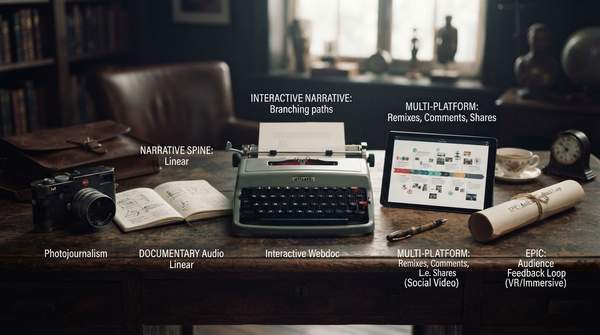
What separates modern digital storytelling from its traditional counterpart is not the screen—it is the loop. Every format worth studying today combines three core elements: a narrative spine that supplies character, tension, and meaning; a medium that supplies the form and its grammar; and a feedback loop through which shares, comments, and remixes carry the story forward and shape what comes next. This article compares five formats—social short-form video, interactive web narratives, data storytelling, long-form documentary, and blended brand stories—across exactly those three dimensions, so you can match a storytelling goal to the structure that best supports it.
The Core Elements of Digital Storytelling
Older frameworks for digital storytelling list seven elements, such as point of view and pacing, but those all sit inside the story and medium layers. A more useful decomposition, articulated in Storyflow's guide to digital storytelling, reduces the craft to three moving parts: the spine, the medium, and the loop. The medium can be video, audio, interactive, social, or data, and each carries its own grammar.
Academic work on "new digital storytelling" in journalism points the same direction. José García Avilés defines the innovation as journalistic production by multidisciplinary teams implementing projects through a variety of resources and formats, with the new formats resting on interactivity, hyperlinking, and multimedia. In other words, a format is not defined by its topic or length but by how these three elements are combined—and the combination varies across journalistic cultures, in both native digital media and the digital editions of legacy outlets.
Feedback Loops: The Digital Differentiator
The feedback loop is what distinguishes digital storytelling from the analog kind. In traditional media, the audience receives the story and the transaction ends. Online, the story is built for a network that carries it forward: shares, comments, remixes, and the analytics that feed the next piece. A dissertation on digital storytelling and online journalism notes that the internet as a medium is far more participatory, interactive, and dialogic than what came before, with increased participation, interactivity, and transparency as defining characteristics of digital journalism.
This is not merely a metrics question. Writing on short-form content observes that short-form storytelling "is not just watched. It is tapped, liked, and co-created. Every interaction becomes part of the narrative." Social platforms make the mechanism visible: as one analysis of emerging digital media trends puts it, the immediacy of platforms like Twitter enables users to share news and opinions while directly interacting with creators, fostering instant feedback and dialogue that shapes ongoing media narratives. The audience is a distribution channel and, increasingly, a co-author.
Digital Storytelling Formats: A Comparative Framework
The table below classifies five formats against the consistent framework of narrative spine, medium, and feedback loop, drawing on Storyflow's format comparison, the Global Investigative Journalism Network's typology of mobile visual storytelling, and research on micro-drama production. Read each row as a balance between narrative control and audience participation: the further right you move, the more the audience shapes the story's path.
| Format | Narrative Spine | Medium | Feedback Loop |
|---|---|---|---|
| Social short-form video (incl. micro-drama) | Byte-sized and visually catchy, or serialized episodes forming a coherent arc | Short vertical video consumed directly on mobile phones | Shares, stitches, comments, likes, and co-creation |
| Interactive web narrative (scrollytelling) | Linear or non-linear visual storytelling, often used for immersion in feature stories | Scrollytelling pages or web experiences using parallax scroll, multimedia, and hyperlinking | Time on page, replays, and links |
| Data storytelling | Explains change over time; may have no main text narrative element, with text and typography part of the visuals | Interactive charts, scrollytelling, graphs, and infographics | Embeds, citations, and screenshots |
| Documentary | Depth and persuasion through sustained narrative | Long-form video or audio | Watch time, discussion, and subscribes |
| Brand story | Trust and positioning | Mixed video, web, and social | Follows, saves, and word of mouth |
The comparison reveals the strategic trade-off at the heart of format choice. Social video buys reach and discovery at low-to-medium production effort but cedes narrative control to the crowd. Interactive web experiences demand high effort and reward it with immersion and exploration. Data stories occupy a middle band: medium-to-high effort, best suited to explaining change over time, with a loop built on embeds and citations rather than viral remixing.
Social Short-Form Video: Engagement in Motion
Short-form video is the format most visibly built for the loop. Research on micro-drama production, published by a team studying viewer feedback-driven content creation on social media, describes micro-dramas as a new mode of byte-sized interaction that extends the logic of short-form engagement on platforms such as Instagram and TikTok into more narrative-oriented entertainment. Unlike typical short videos that prioritize visually catchy moments or meme-driven snippets, micro-dramas adopt a serialized structure: byte-sized for asynchronous, scroll-based consumption, yet unfolding through sequential episodes that collectively form a coherent narrative arc.
Crucially, the loop reaches into production itself. The micro-drama study finds that while real-time incorporation of viewer comments has not yet become an industry-wide practice, some creators have begun integrating such feedback during continuous updates, adjusting narrative structures and character development to the constraints and affordances of the vertical-screen format. Content consumption, in short, has adapted to direct phone viewing—and creation is adapting in response.
Interactive Web Narratives: Immersive Journeys
At the opposite end of the control spectrum sits the interactive web narrative. The Global Investigative Journalism Network's survey of visual storytelling on mobile highlights long-form scrollytelling as linear, narrative visual storytelling used mostly in feature stories, with parallax scroll creating smooth transitions between parts of the story. Named examples include the BBC World languages service's "Modern women in the land of Genghis Khan," the New York Times' "How I learned to look believable," and the Washington Post's "Six teens and the wounds they carry," with tools like Shorthand used in newsrooms such as the BBC.
Instagram Stories from the Guardian, Washington Post, and New York Times extend the same logic into social channels. Here the feedback loop is quieter but real: time on page, replays, and outbound links measure whether the immersive journey holds attention. Design itself carries narrative weight in digital journalism, and the reader's scroll becomes the pacing mechanism.
Data Storytelling and Blended Media: Visualizing Insights
Data storytelling is the format where the medium most nearly is the message. The GIJN typology groups data visualization, visual essays, visual stories, and blended media storytelling as graphs, infographics, interactives, or highly visual stories that may have no main text narrative element at all—the text and typography are part of the visuals. Exemplars include the Guardian's "Bezos empire" and "How Cape Town is running out of water," the Washington Post's "How key senators changed their positions to bring down Obamacare repeal," and The Pudding's "Music borders."
Its loop is distinctive: rather than stitches or comments, data stories travel through embeds, citations, and screenshots—other writers and analysts reusing the visual evidence inside their own narratives. A dissertation on digital storytelling notes that web information is often broken into screen-sized chunks and keywords, with brief overviews and subheadings giving readers an initial orientation; data stories push that logic further by making the visual element the primary carrier of meaning.
Designing for the Loop: A Strategic Imperative
The comparative framework points to one decision that applies across all five formats: creators should intentionally design digital stories to incorporate and leverage audience feedback mechanisms as an integral part of the narrative's distribution and evolution, moving beyond traditional one-way communication. The micro-drama research shows this is already happening at the level of production, with viewer feedback and platform-generated data driving content iteration; the journalism scholarship shows it happening at the level of form, with interactivity and participation built into the storytelling itself.
The measurable indicator is concrete: increased audience shares, comments, and remixes, along with positive analytics indicating active participation and narrative co-creation. Choose your format by matching goal to structure—reach for serialized short video, immersion for scrollytelling, explanation for data visuals—and then design the loop in from the start, because in digital storytelling the audience's response is not the end of the story but part of how it gets told.
Sources
- What Is Digital Storytelling? The Complete Guide (2026) — Storyflow
- Taylorfrancis
- ETD
- MEDIUM
- Navigating the Future: Emerging Trends in Digital Media in the Contemporary Era – Mass Comm Notes — Masscommnotes
- GIJN
- Audience in the Loop: Viewer Feedback-Driven Content Creation in Micro-drama Production on Social Media — ARXIV