Gothic Lolita is a Japanese street-fashion subculture that fuses Victorian and Rococo dress with dark "gothic" imagery and Japanese kawaii—cuteness—into a look that is unmistakably its own. It emerged in 1990s Japan, where academic analysis reads it as escapism and a rejection of sexual objectification and traditional gender roles. When Western enthusiasts adopted it, they kept the silhouette but reinterpreted the meaning, emphasizing community, creativity, and personal fantasy. Understanding those four defining elements—and how each one's significance shifts across cultures—is the key to distinguishing Gothic Lolita from both its birthplace and the Western Goth subculture it is often mistaken for.
The Origins of Gothic Lolita: A Blend of Eras and Cultures
Gothic Lolita did not invent its wardrobe from nothing. Its dresses, lace, and bows draw directly on eighteenth- and nineteenth-century European fashion, and its admirers romanticize the lives of European nobility and upper-class girls of that era—Marie Antoinette and Lewis Carroll's Alice are recurring touchstones, according to an analysis in New Voices in Japanese Studies. The style's deliberate impracticality is part of the point: its "total lack of functionality" encourages wearers to adopt demure, elegant mannerisms as part of the aesthetic.
Scholar Okamura Keiko's theory of "format" and "product," cited in that same analysis, explains the mechanism: historical European fashion styles became transnational, were localized in Japanese culture, and then hybridized with the local aesthetic notion of cute, producing a fashion form peculiar to Japan. In other words, Gothic Lolita is not a European costume revived—it is a Japanese cultural product built from borrowed European raw material.
Defining Elements: Dark Aesthetics and Doll-like Innocence
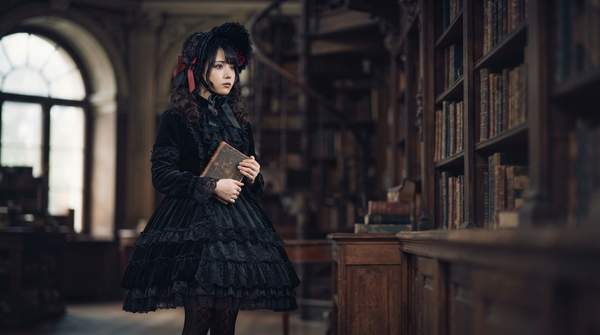
The style's visual grammar rests on a recognizable silhouette: a knee-length skirt or dress supported by petticoats to create a bell or A-line shape, layered with ruffled collars, puffed sleeves, and delicate lace, as the fashion magazine Yokogao describes. Onto this foundation, Gothic Lolita adds its signature darkness—bats, coffins, skulls, crosses, and blackness—alongside makeup described by The Mourning Paper as "sickly yet stunning," embracing a doll-like core inspiration. Many wearers, following the example of the style's most famous figure, use wigs to heighten the effect.
Crucially, the darkness never fully wins. As the name Gothic & Lolita itself indicates, the style equally emphasizes sweetness, girlishness, and elaborateness. Within Japanese culture, the name "Lolita" refers to cuteness and elegance rather than sexual attractiveness—and many Lolitas in Japan are unaware of, and disgusted by, the Nabokov association, as Wikipedia's contributors note. The blend of dark and cute is not a contradiction to be resolved; it is the style's defining condition.
Philosophical Underpinnings: Escapism and Self-Expression
An academic overview of the subculture argues that Lolita emerged in 1990s Japan as a response to socio-economic instability and traditional gender roles, combining Gothic elements with kawaii culture to emphasize innocence and escapism. On this reading, the fashion promotes women's visibility in society while resisting sexual objectification: the doll-like modesty is armor, not invitation. The wearer's body is covered, framed, and reframed on her own terms.
That subversive quality travels, though it changes shape. CNN, citing scholar Monden, reports that the style's refusal to subscribe to norms of what "mature femininity" looks like for adults—worn by people in their late teens, 20s, 30s and beyond—makes Lolita fashion a subversive form of self-expression. The philosophical core survives the crossing; the specific social pressures it answers do not always translate intact.
Gothic Lolita vs. Western Goth: A Clear Distinction
The comparison in New Voices in Japanese Studies is blunt: Western Goths are generally defined by their embrace of darkness and gloominess, and Western Gothic often symbolizes rejection of and rebellion against mainstream culture. Gothic Lolita shares the gloomy imagery—bats, coffins, skulls, crosses, blackness—but it is "considerably distinctive from the Western Gothic in terms of style, but also conceptually."
The difference is directional. Western Goth faces outward, against the mainstream; Gothic Lolita turns inward, toward an idealized, romanticized world of elegance and innocence. One is rebellion; the other is escapism dressed in rebellion's clothes. An academic overview of the subculture reaches the same conclusion from the Japanese side, framing Goth-Loli as resistance to objectification rather than generalized cultural defiance. Members of the subculture themselves recognize the distinction, which is why the two scenes, despite superficial overlap in palette, remain separate worlds.
The Global Spread: Key Figures and Media Influence
The style's international journey has identifiable carriers. Mana, the visual kei musician associated with Malice Mizer and his fashion label, became the style's visual archetype. As The Mourning Paper recounts, Malice Mizer and the Visual Kei movement helped the Gothic Lolita subculture become popularized internationally: through early internet forums and scanned spreads from the Gothic & Lolita Bible magazine, Mana's image traveled far beyond Japan, inspiring international fans to adopt and adapt the style within their own alternative communities.
The Gothic & Lolita Bible itself deserves credit as infrastructure. The magazine catalogued clothing brands distributing Gothic Lolita-style clothing, and the New Voices analysis reads this as evidence of the style's mass-marketed nature and its aim to encourage casual participation. The same digital channels that spread Mana's image also spread the magazine's coordinates, giving Western fans a template to copy and, eventually, to modify.
Western Adoption: Reinterpretation and Community
What Western enthusiasts found in the style was not identical to what Japanese wearers had built. The New Voices analysis frames Gothic Lolita as a case of transcultural flow: cultural forms circulate in multiple directions, and what returns to the West is transformed. Perry R. Hinton's study in the International Journal of Communication notes that the style gained a cult following in the West despite the apparent incongruity of its name—Victorian doll clothes bearing a label loaded with unrelated Western literary baggage.
In practice, Western adoption centers on community and personal expression rather than the specific Japanese socio-cultural resistance. CNN's reporting on Western Lolita communities—tea parties in Oakland rose gardens, kimono-style dresses in San Francisco's Japanese Tea Garden—captures a scene organized around gathering, coordinating outfits, and shared enjoyment. The fashion becomes a creative identity and a social world, a personal fantasy made wearable, rather than a stance against a particular Japanese social context the wearer never inhabited.
Gothic Lolita: A Transcultural Comparison of Elements and Meanings
The table below juxtaposes each defining element with its conceptual underpinning in Japan and its reinterpreted meaning in the West, so the cultural shift is visible at a glance.
| Aesthetic Element | Japanese Origin & Meaning | Western Interpretation & Adaptation |
|---|---|---|
| Victorian/Rococo influence | Elaborate dresses, lace, and bows drawn from 18th–19th-century European fashion; romanticized European nobility; deliberate impracticality encouraging demure mannerisms. | Retained as the foundational aesthetic; appreciated as historical costume and creative canvas rather than as a commentary on Japanese gender norms. |
| Dark "Gothic" aesthetics | Bats, coffins, skulls, crosses, and blackness blended with sweetness and girlishness; "sickly yet stunning" doll-like makeup. | Adopted as dramatic self-presentation; the dark imagery is styled for symbolic effect within alternative communities rather than read through Japanese social critique. |
| Doll-like silhouette and kawaii aesthetics | Bell-shaped petticoat silhouette expressing cuteness and elegance; "Lolita" means innocence in Japanese culture, explicitly detached from sexual connotations. | Worn as subversive self-expression that rejects norms of "mature femininity"; the name's Nabokov association is a persistent point of confusion to be actively disavowed. |
| Philosophical underpinnings | Academic analysis reads the style as escapism and resistance to sexual objectification and traditional gender roles amid 1990s socio-economic instability. | Reinterpreted around community-building, creative expression, and constructing a personal fantasy world, per enthusiast accounts and studies of transcultural adoption. |
Embracing Gothic Lolita: A Global Expression
Readers interested in alternative fashion can confidently identify Gothic Lolita's unique blend of aesthetics and understand its distinct cultural significance, differentiating it from Western Goth: the same skulls and crosses, but pointed at innocence and elegance rather than rebellion and gloom. The measurable indicator of that understanding is simple: the reader can articulate the core elements and philosophical distinctions of Gothic Lolita when encountering the style or discussing alternative fashion subcultures—naming the Victorian and Rococo roots, the dark-cute hybrid, the kawaii core, and the shift from Japanese social resistance to Western community and self-expression.
Sources
- Academia
- Transcultural Flow of Demure Aesthetics — Newvoices
- Lolita Fashion Explained - A Tale of Lace, Frills, and Quiet Rebellion │Yokogao Magazine
- Lolita fashion - Wikipedia — EN
- Lolita style, explained: Why the Japanese-born, Victorian-inspired street style enchants women around the world — CNN
- The History and Influence of Gothic Lolita — The Mourning Paper