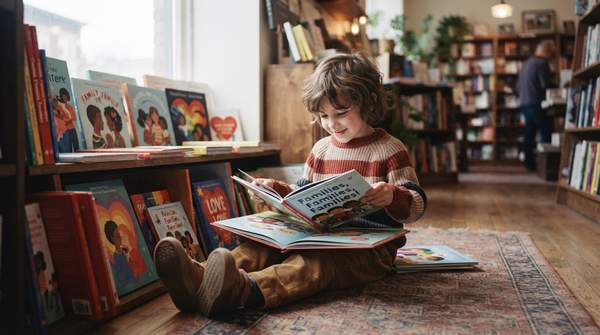
LGBTQ+ inclusive picture books have undergone a significant transformation, evolving from subtle, often niche publications to more explicit and affirming narratives that address a broader spectrum of identities and experiences. This evolution reflects changing societal attitudes and a growing recognition of the importance of diverse representation in children's literature, though notable gaps in representation persist for certain identities.
These books serve a crucial cultural function, acting as both "mirrors" for children to see themselves reflected and "windows" through which they can understand others. This dual role is vital for fostering identity formation, empathy, and a sense of belonging among young readers. Despite their increasing presence and impact, LGBTQ+ picture books continue to face challenges, including censorship attempts, which underscore the ongoing struggle for inclusive representation in children's media.
The Evolving Landscape of LGBTQ+ Picture Books: A Historical Overview
The journey of LGBTQ+ children's picture books began subtly, with overt representations of LGBTQ+ identities and experiences being a relatively recent development in children's literature. Before 2000, these books were often published by small feminist presses or self-published, resulting in modest circulation, according to an overview from Lumen Learning's LGBTQ+ Studies open textbook. Early works frequently depicted same-sex parent families, sometimes portraying them as secret, unusual, or misunderstood by teachers, reflecting the prevailing societal norms and challenges of the era.
A significant acceleration in the appearance of LGBTQ+ children's picture books occurred post-2010. This shift has led to more recent books that are explicitly affirming of both same-sex parents and LGBTQ+ children themselves. These contemporary narratives often appeal to a broader audience by exploring themes of diversity, inclusion, and daily life, moving beyond earlier, more cautious portrayals. This progression highlights a deliberate move towards more positive and explicit representation within children's literature, as noted in a study published by Frontiers.
Emerging Themes and the 'Mirror and Window' Concept
Contemporary LGBTQ+ inclusive picture books are characterized by several emerging themes that support their use in elementary education, as identified by Enoch Leung and Julia Adams-Whittaker in research published by Frontiers. These themes include diversity and inclusion across various populations, such as family structure, sexuality, gender identity and expression, ethnicity, disability, sex, and individual differences. Other prevalent themes involve anthropomorphism, depictions of daily life with positive support, challenges to stereotypes, and overarching educational goals.
Central to the cultural significance of these books is the "mirror and window" concept, a framework highlighted in the Frontiers research. This concept, originally articulated by Rudine Sims Bishop, posits that books serve as "mirrors" when children see their own lives and identities reflected in the stories, fostering self-recognition and validation. Conversely, books act as "windows" when they offer children glimpses into the experiences and perspectives of others, cultivating empathy and understanding. For LGBTQ+ children, seeing their identities affirmed in books can be profoundly impactful for positive identity formation and a sense of belonging. For all children, these books provide opportunities to learn about and accept diverse family structures and identities, thereby disrupting assumed norms and fostering a more inclusive worldview, as discussed in a review of Miller's work in the *International Journal of Communication*.
Addressing Representation Gaps: Beyond the Visible
Despite the progress in LGBTQ+ representation, significant gaps persist for certain identities within children's picture books. Danika Ellis, writing for Book Riot, points out that while "firsts" are still being celebrated—such as the recent release of a traditionally published picture book about aromantic and asexual identities—many identities under the 2SLGBTQIAA+ umbrella have minimal to no representation in children's literature. Specifically, Two-Spirit, intersex, and agender individuals are among those with hardly any presence in these books.
The lack of representation for these identities means that children who identify with them may not find "mirrors" in literature, potentially hindering their self-acceptance and sense of validation. For instance, while efforts like the Paths (Re)Membered Project have published books such as "Sassy Sassafras: A Two Spirit Story" to address the need for Two-Spirit narratives, comprehensive representation remains a challenge, as reported by Underscore Native News. The absence of these stories also limits the "windows" available for other children to understand and empathize with the experiences of Two-Spirit, intersex, and agender individuals, thereby impeding broader cultural understanding and acceptance. The Diverse BookFinder emphasizes that seeing oneself and one's family reflected in books is crucial for children, making these representation gaps particularly impactful.
Challenges and Champions: Censorship and Independent Publishers
The increasing visibility of LGBTQ+ picture books has not been without its challenges, most notably persistent attempts at censorship. Author Gayle Pitman, for example, has noted recent efforts to ban her books in states like Colorado, Texas, and Illinois, according to Lumen Learning. These challenges often stem from a "fear of change and fear of differences," as observed by the Carle Museum, which highlights that such censorship limits opportunities for students to use these books as both mirrors and windows, thereby hindering understanding and acceptance.
In this landscape, independent publishers play a crucial role in promoting diversity and inclusion. These publishers often step in to provide LGBTQ+ books, especially when mainstream avenues face resistance or challenges. For instance, an independent publisher in the United Kingdom was specifically chosen for a study by Enoch Leung and Julia Adams-Whittaker because its mission is to provide literature for educators to address the need for LGBTQ+ representation and promote discussions around diversity and equity. Their efforts are essential for ensuring a broader range of voices and stories reach young readers, counteracting the pressures of censorship and fostering a more inclusive literary environment.
Cultural Significance for Children's Identity Formation
The cultural significance of diverse LGBTQ+ representation in children's literature is profound, directly impacting children's identity formation and their ability to navigate a complex world. As the Diverse BookFinder emphasizes, it is vital for children to see themselves and their families reflected in the books they read. This inclusive representation fosters a sense of belonging and validates their experiences, which is particularly critical for LGBTQ+ children who may otherwise feel invisible or marginalized.
The "mirror and window" concept, as discussed by Enoch Leung and Julia Adams-Whittaker, encapsulates this impact. When children encounter stories that mirror their own identities, it reinforces self-acceptance and builds confidence. Simultaneously, books that offer windows into diverse LGBTQ+ lives cultivate empathy and understanding among all children, helping them to appreciate differences and challenge preconceived notions. This exposure can disrupt assumed norms and create "imagined queer collectives," fostering feelings of community and belonging, as suggested by Miller's work reviewed in the *International Journal of Communication*. Ultimately, these books contribute to a more inclusive society by shaping young minds to be more accepting, understanding, and empathetic towards themselves and others.
Sources
- Profile: LGBTQ Children’s Picture Books | LGBTQ+ Studies: An Open Textbook — Courses
- Frontiers | Content Analysis of LGBTQ Picture Books for Elementary Education Through an Intersectional Lens — Frontiers
- IJOC
- What's Next for LGBTQ Picture Books? — BOOK RIOT
- New Children’s Book Tells Story of Young Two-Spirit Person - Underscore Native News — Underscore Native News
- LGBTQ+ Representation in Diverse Picture Books - Diverse BookFinder — Diverse BookFinder
- Bringing LGBTQ+ Picture Books into the Spotlight — Carle Museum


