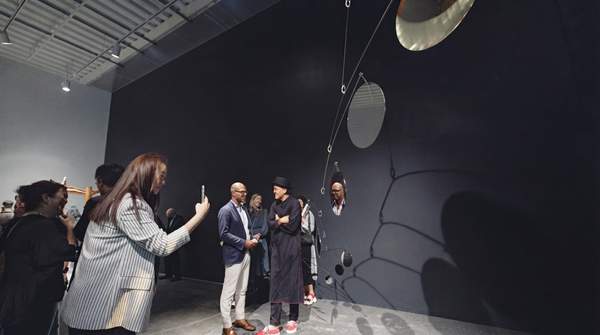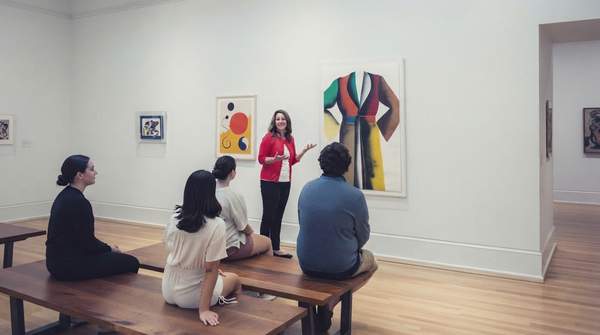
FISK Gallery operates in the lobby of Wieden+Kennedy, one of the world's most famous advertising agencies, and its curator, Bijan Berahimi, makes a point of giving commercial artists a chance to make work outside of brand briefs and pitch decks. That arrangement is a compact example of a broader shift: the boundaries between commercial and fine art are dissolving, and the most interesting venues are the ones that deliberately occupy both territories. This article uses FISK as a case study and supplies a reusable conceptual framework—the three subfields of the contemporary art world—for analyzing any hybrid art space.
Introduction: The Blurring Lines in Contemporary Art
The old assumption was that commercial art and fine art lived in separate buildings with separate audiences. Advertising happened in agencies; painting and sculpture happened in galleries and museums. FISK collapses that geography by placing a fine art exhibition program physically inside an advertising agency's workspace, a dissonance the critic reviewing its show "Heaven Must Be Near" noted directly, observing that the exhibition "leverages that dynamic" rather than hiding it.
The stakes of that blurring extend beyond one Portland lobby. Marie Ballarini's thematic synthesis of the literature on gallery business models describes art galleries as occupying "a unique position at the intersection of art and trade, supporting artists, supplying collectors and interacting with cultural institutions." Galleries were never purely cultural or purely commercial, but hybrid spaces like FISK make the mixture explicit and raise practical questions for artists and collectors about how value and legitimacy are produced when the two spheres merge.
Understanding Hybrid Art Spaces: A Subfield Framework
The analytical tool for this article comes from artist and writer Andrea Fraser, whose 2024 diagram of the field of contemporary art divides the art world into three interdependent but relatively autonomous subfields. Each subfield runs on a different currency, and a hybrid gallery can be diagnosed by identifying which functions it performs and how it converts one currency into another.
| Subfield | Primary driver | What it confers | How FISK participates |
|---|---|---|---|
| Market | Economic exchange of art; sales and financial value | Revenue and commercial reach | Hosted by a commercial entity (Wieden+Kennedy) rather than a standalone gallery |
| Exhibition | Presenting art to the public; attention and experience economies | Cultural prestige and legitimacy | Mounts fine art exhibitions that give commercial artists a platform outside client work |
| Academic | Artistic research, theoretical discourse and knowledge production | Intellectual framing and critical context | Indirect: the gallery's premise invites critical discourse about commerce as aesthetic experience |
Applying the framework to FISK shows a gallery that simultaneously participates in multiple subfields. It leverages commercial resources—an agency's lobby and its creative workforce—to generate exhibition-subfield legitimacy, and it uses exhibition practices to elevate work that would otherwise remain commercial. Fraser's analysis explains why this exchange works: for-profit galleries and art fairs compete "within attention and experience economies and for cultural legitimacy, which, in turn, elevates the value of artworks they do sell above that of mere luxury goods." Cultural capital converts into economic capital, and hybrid spaces are built on that conversion.
FISK Gallery: A Case Study in Hybridity within Wieden+Kennedy
FISK's defining feature is physical and organizational. It is not a gallery near an agency or funded by one; it operates within the Wieden+Kennedy building, integrating fine art exhibitions into a working commercial environment. The reviewer of "Heaven Must Be Near," a ceramics-focused show, described the setting's dissonance as productive rather than awkward, noting that the exhibition leverages the tension between fine art display and advertising culture.
The curatorial mission completes the hybrid picture. Berahimi deliberately recruits commercial artists and gives them room to produce fine art free of client constraints. In subfield terms, FISK takes practitioners rooted in the market subfield—people whose creative labor normally serves brands—and grants them exhibition-subfield standing. Fraser notes that many artists exist in one subfield "with no presence in the others," including artists who consistently sell but have no professional reputation outside the commercial world. FISK's program is designed precisely to move artists across that line.
The gallery's location also sharpens its argument. The Willamette Week review observes that advertisements and other commercial art are "the most frequent aesthetic experiences we have" and arguably the most impactful on a societal scale. By exhibiting fine art where commercial art is made, FISK puts the two traditions in direct conversation.
Implications for Artists: Navigating Commercial and Cultural Spheres
For artists, hybrid spaces offer a route to cultural legitimacy that does not require abandoning commercial work. FISK's model treats a commercial background as an asset rather than a disqualifier, converting market-subfield skills into exhibition-subfield credentials.
Some artists already work both sides of the boundary from within their practice. Jason Foumberg's 2013 review of Carson Fisk-Vittori's work at Carrie Secrist Gallery describes photographs and sculptures that "unabashedly employ the design tactics of advertising and commercial art," with shampoo bottles and dishwashing soap arranged so that the pieces "almost come across as absurdist product endorsements rather than works of fine art." Foumberg connects this to a broader cohort of Internet-era artists who "generate meaning through appropriation" and move fluidly between online platforms and physical galleries.
Fisk-Vittori's example illustrates the mechanism the framework predicts. An artist fluent in commercial aesthetics gains exhibition-subfield attention in a physical gallery, and that cultural recognition, per Fraser's analysis of how exhibition legitimacy elevates market value, feeds back into the artist's overall standing. Hybrid venues institutionalize this loop rather than leaving it to individual improvisation.
Implications for Collectors: Valuing Art in a Blended Market
Collectors evaluating work from hybrid spaces need to read two signals at once. The first is commercial backing: FISK's connection to Wieden+Kennedy provides infrastructure and audience that a standalone gallery might lack. The second is artistic intent: the gallery's stated purpose is to free artists from client briefs, meaning the work on display is positioned as fine art even when its makers earn their living commercially.
Ballarini's synthesis frames galleries as gatekeepers alongside auction houses, dealers and art fairs, occupying the intersection of art and trade. In a blended market, that gatekeeping function becomes harder to read from the outside: a venue's commercial context does not tell you whether its exhibitions are market-driven or prestige-driven, and often they are both. The practical test is not the address but the program—whether the space mounts exhibitions that build an artist's cultural reputation, which Fraser identifies as the mechanism that lifts artworks "above that of mere luxury goods."
It is worth noting what this analysis cannot do. It is based on publicly available reporting and academic models, not on inside information about FISK's or Wieden+Kennedy's business operations, and it is not financial investment advice. The framework describes how value is structured, not what anyone should buy.
Navigating the Hybrid Art Landscape: A Decision for Artists and Collectors
The decision this analysis supports is straightforward: artists should strategically consider hybrid art spaces for opportunities to gain cultural legitimacy and expand their market reach, while collectors should evaluate art from these spaces by recognizing the interplay between commercial backing and artistic intent. FISK demonstrates that a gallery inside an advertising agency can function as a legitimate exhibition venue precisely because the subfields are interdependent—commercial resources fund cultural prestige, and cultural prestige enhances market value.
The measurable indicator to watch is the increased presence of galleries within non-traditional commercial venues and a growing number of artists successfully transitioning between commercial and fine art projects. FISK's program of moving commercial artists into fine art exhibition is one documented instance; each new gallery embedded in a workplace, retail space or agency, and each artist who crosses from brand work to gallery walls, is a data point confirming that the blurring is structural rather than incidental.
Sources
- Inside Wieden+Kennedy, FISK Gallery Blurs Commercial and Fine Art — Willamette Week
- The Field of Contemporary Art: A Diagram - Notes - e-flux — E FLUX
- BUSINESS MODELS OF CONTEMPORARY ART GALLERIES AND ART FAIR INFLUENCE: A THEMATIC SYNTHESIS OF THE LITERATURE — ACEI
- Review: Carson Fisk-Vittori/Carrie Secrist Gallery — Newcity Art