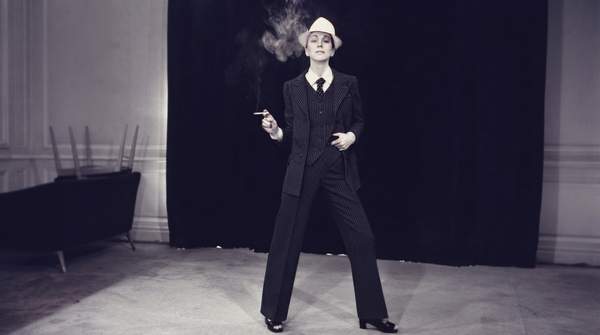
Three developments in 20th-century Western fashion did disproportionate work in dismantling the idea that clothing must announce a fixed gender role: Coco Chanel's little black dress of 1926, women's gradual adoption of trousers from the 1930s onward, and Yves Saint Laurent's 1966 tuxedo for women, 'Le Smoking'. Each attacked the gendered dress code by a different route—rejecting restrictive silhouettes, appropriating menswear, and inventing a new vocabulary of feminine power dressing. Comparing them side by side reveals not one revolution but three distinct strategies for redefining gender expression through what women wore.
Fashion as a Fluid Expression of Identity
Why did a dress, a pair of trousers, and a tuxedo carry such weight? Because clothing functions as the outward expression of identity, and gender norms—the traditional roles society assigns based on perceived gender identity—are read directly off what a person wears. An academic analysis of fashion and gender makes the mechanism explicit: if you saw a woman wearing a tuxedo, you might attribute masculinity to her, because the idea of a woman in a tuxedo goes against traditional gender norms.
That reading is precisely what made these garments politically charged. The same analysis notes that gender is directly correlated with fashion because clothing is used as the outward expression of one's identity. A garment that violates the expected code does not merely look different; it destabilizes the viewer's ability to categorize the wearer, which is why fashion became a recurring site of contest over gender itself.
The 1920s Liberal Spirit: Chanel's Little Black Dress
Before the 1920s, women's clothing was characterized by elaborate embellishments, corsets, and voluminous skirts. Chanel's vision was to simplify women's attire, providing both comfort and style without sacrificing sophistication. The little black dress, introduced to the world through an illustration in American Vogue's October 1926 issue, marked a significant departure from those traditional norms—a long-sleeved, knee-grazing black dress whose silhouette appears demure, even conservative, by today's standards, but which in 1926 epitomized the liberal spirit of the Roaring Twenties.
The color choice was itself a provocation. Chanel dismissed class-driven notions that black clothes were the uniform of house servants and funerals, and the design was initially met with skepticism because black was traditionally associated with mourning and somber occasions. Its sleek silhouette and understated elegance nonetheless won over modern women seeking practicality and grace. Writing on design simplicity, Jin Kang Møller frames Chanel's move as an act of empathy for "women with heavy hats and dragging dresses"—a designer recognizing the pain of the user and removing it. The LBD's challenge to gender norms was thus indirect but foundational: it freed the female body from constriction and recast femininity as ease rather than ornament.